Tuesday, 18 October 2011

To Kill a Mockingbird

To Kill a Mockingbird
Ashlea Shaw

Genre: Literature/Classic.


Age Group: This book is suited for all ages from 12 and up.


Stars: Book - 5 stars
Movie - 3 stars


Book Review


Harper Lee’s To Kill a Mockingbird is the very reason why people read. It is loosely based on real events that happened to Lee’s neighbours when she was a little girl. This is such a great book! I’ve read it a few times and each time I read it I love it a little bit more. It is such a sad story, and Lee has no trouble addressing the racism that unfolds and is still the case today over 50 years later. Harper Lee has sufficiently set the scene for the story and also shows us what life is like through her sense of imagery and descriptions, of Maycomb County and the people that live there. Her portrayal of one, Atticus Finch, and a rape trial so full of emotion and horror it brought me to tears. The characters in this story are brilliantly defined and well thought out; the storyline is relatable and heart-warming; and the setting is realistic. She was a very courageous person to address it at the time that she did, and had to put up with a lot of criticism surrounding her only novel. She had a voice that she wanted to be heard, and a message she wanted to be sent out and she has done both things perfectly in this story. Her style is straight-forward and to the point – she writes simply, however, she manages to do it elegantly and effectively. The prose is beautiful and light-hearted coming from the eyes of a young girl named Scout, yet, she has managed to capture a moment that is so serious and mingle the two together effortlessly.

Movie Review


In this black and white film adaptation of To Kill a Mockingbird starring Gregory Peck, the storyline has been kept fairly close to the book of the same name. Yes, it’s an old movie and the special effects aren’t in the same league as they are today, but the story itself is what sets this movie apart from others. The music is typical of a film made in that era – in other words when something bad is about to happen, that awful music reminiscent of the Jaws movies (I know Jaws was made long after this, but you catch my drift!). Gregory Peck is the perfect choice for Atticus Finch and his ability to play the ever solemn lawyer/ father/philanthropist all mixed in to one, is no mean feat. The movie is still packed full of the same action that can be read in the book. The young actress who plays Scout Finch (the narrator of the book) is one of those children who is both exceptionally obnoxious but exceptionally loveable at the same time and I loved watching her get in to mischief with her big brother Jem. I would’ve liked to have seen more of Boo Radley in the film since he was such a vital part of the book, but he is only seen towards the very end of the film. I think this was a mistake on behalf of whoever wrote the script because it detracts from the movie for those that have read the book first. The town itself is just like what I’d imagined it to be – quiet, sleepy and everyone knows each other’s business. I would love to see a remake of the film in colour simply because I think it would add to the overall picture of the town.


Comparison


Once again, the book is far superior to the movie. In this instance though, the movie was going to have to be one of the best ever made to beat out the book. Lee’s written word is just too good to be topped and it’s a shame that she chose never to write another novel again. Overall I would recommend both the book and the movie to anyone wanting to read a book that will stay with them and touch them as much as it touched me. So whether you choose to read the book or watch the movie, this story by Harper Lee will resonate in your minds forever and you will find yourself wanting to go back to it over and over again.

Inkheart

Review By Phil Gray


‘Step away from the book, sir, hands behind your back and up against the wall’. The book police are in town, or at least they would be if Cornelia Funke’s book, Inkheart, was real. Mo ‘Silvertongue’ Folchart has been banned from reading out loud. Not because he has a really annoying voice, or a lisp, or doesn’t know how to pronounce tomato. He doesn’t read out loud because when he does book characters come out of the book and into the real world. Now doesn’t that sound exciting, yes, it does sound exciting; unfortunately I’m being ironic. The excitement stops shortly after the whole premise of bringing story book characters to life. I’m warning you now, this is the first book I’ve had a fight with. I actually punched it because I got so frustrated with the stupid characters and lame dialogue. The book came off better than me, I had to put my hand in ice (it’s quite a thick book).

The news doesn’t get any better, it’s a trilogy. Three books of lame dialogue and drippy characters. Maybe the real magic got lost in translation as the author, Cornelia Funke, is German and the book was originally written in German. Then again, I’ve read All Quiet on the Western Front, that was translated from German and that was awesome. Putting the translation problems aside, the book at its heart is a travelling adventure romp suited, in my opinion, to teenage girls. The daughter protagonist, Meggie Folchart, will keep teenage girls interested enough, until they grow out of My Little Pony. Like any girl hitting her teenage years, Meggie Folchart is gradually pulled out of her childhood by the general weirdness of the world around her. Her abilities (making book characters come alive) kick in shortly after being scared to death by some scary story book people.

Got any silly putty or play doh? I’ve invented a new game; it’s called ‘Bendy Brendon Fraser Face’. Catchy, eh? All you need is a film DVD or Blu-ray staring Brendon Fraser, such as Inkheart and some material you can mold with (even blu-tack will do). Pause the film at an opportune moment, when Brendon Fraser is using his special jowl power. Then as quickly as you can, remake that face with your preferred craft material. See if your friends can guess which film your ‘Bendy Brendon Fraser Face’ comes from! I used the scene just after Meggie Folchart (played by Eliza Bennett) says ‘My mother? What’s this got to do with my mother?’. It’s about nine minutes and three seconds into the film and it’s a classic (recreate the same masterpiece I made).

After all that fun, the film suffers from lame dialogue and lack lustre acting. True, as a child you’ll probably be able to overlook these flaws but as adult you’ll be asking for your money back. Capricorn the main villain (played by Andy Serkis) is about as scary as a handful of rainbows and gum drop flavoured care bears. His threatening behaviour doesn’t work, he was fantastic as Golem in The Lord of the Rings and very convincing in King Kong, but in Inkheart he’s a bit of a potato. Actually if you pause Inkheart, when there’s a close up of Andy Serkis’s face, you can make an evil looking Mr Potato Head out of your left over craft material. The only redeeming character in this film is Dustfinger (played by Paul Bettany), his scars look real and he can blow a fireball out of his left nostril.

By now you’re probably asking which could be better out of this lame attempt at entertainment. I don’t know if I can gather my strength enough to compare the two different mediums. The book has only one scene that rang true with me and made me actually care about the characters. It’s the short chapter named Going Home, it’s the part when Elinor Loredan (the book crazed aunt) comes home and finds all of her books have been destroyed. The emotion in that scene nearly made me forgive all lameness that surrounded it. It’s sad because the book could have been so good. Having a quote from a (better) real book at the beginning of each chapter doesn’t help either, as it highlights the rubbish that you’re reading. If only I was a teenage girl maybe I could enjoy it.

Yes, that means I’ve decided the film is better than the book. Not because I lost in a fight with the book (we've made up now and are going out for hot chocolate next week). It’s due to the fact that Paul Bettany (Dustfinger) and his little furry horned friend can act. Paul Bettany has done an amazing fete of making lame dialogue and bad story plotting reasonably interesting. Plus watching him spin fire is kind of cool. I wish I could do that. Instead I’m going to find more films with Brendon Fraser in so I can continue playing ‘Bendy Brendon Fraser Face’. I think Bedazzled will be next.


Saturday, 15 October 2011

The Hitchhiker's Guide to the Galaxy

By Peta Hawker

The Hitchhiker’s Guide to the Galaxy was originally a radio broadcast that was started in 1978 by Douglas Adams. Later, it adapted to different formats; a ‘trilogy’ made up of five books, a TV series, a comic book series, and lastly, the 2005 film.

Reading the novel version of this utterly unique story held a sense of completion for me. Even though the television series was made before my time, I grew up watching it on VHS with my dad. I have such fond recollections of a blonde-haired Trillian, a Ford Prefect who was somewhere between Tom Baker and Michael Palin, and of course, a Marvin the depressed robot that looked like a whole stack of alfoil-lined boxes piled together. When the movie came out in 2005, I watched it without disappointment. This is why reading the novel, finally, was like completing what I started with my dad nearly 20 years ago.

Douglas Adams, the author of The Hitchhiker’s Guide, has a remarkable sense of humour and a peculiar way with language. My absolute favourite sentence from the book was when Arthur Dent is searching for a cup of tea on the spaceship: ‘He had found a Nutri-Matic machine which had provided him with a plastic cup filled with a liquid that was almost, but not quite, entirely unlike tea’ (Chapter 17). As I once read in an excellent grammar book, it is only once you understand the rules that you can break them, and Adams is a perfect example of this. Given that the plotline of the book is somewhat erratic, the character development is quite important, and Adams achieves realistic individuals with ease. Zaphod Beeblebrox is actually quite smart, and has a few pressing issues he is dealing with. Trillian is, in fact, a mathematician and astrophysicist who couldn’t find a job on earth, but fits in perfectly in space. The awkward love triangle between Arthur, Trillian and Zaphod simmers under the surface of the story line and causes tension points, particularly between the two men. All in all, the book is an excellent example of Adams’ ability to craft and manipulate language to create a completely unique experience for the reader.

The movie, released in 2005, contained very different looking characters to those I remembered from the television series.  Fortunately, it had been a good 10 years since I had seen the show, and though the images of the characters were still in my mind, I was able to comfortably watch the new versions. Perhaps the best thing about the film is the knowledge that Adams himself wrote the screenplay for it, before his death in 2001. The difference between an author reimagining his work onto screen, and somebody else turning another author’s work into a film is very obvious when watching the film. Adams’ sense of humour is not lost, and much of the dialogue remains true to the original. Stephen Fry as the narrator was an excellent choice; his excerpts from the Guide take on an extra quirky note when he reads them. Martin Freeman was also a great choice; he manages to pull off the bewildered, lonely, tea-loving Arthur Dent with ease. The animations used to illustrate the excerpts from the Guide are fun and adequately attempt to find some harmony amidst the chaos that is Adams’ work.

To compare the novel with the movie is an interesting task, to show that one is better than the other seems impossible. Each version gives something that the other inherently lacks. The movie is able to show the sweeping scenes of space and planets that one could only imagine before. As it has been said, a picture is worth a thousand words, and in this case it is true. Reading about Earth’s reconstruction is nothing compared to watching the various vistas unfold before Arthur Dent; it is almost like watching a fantastic Attenborough documentary. At the same time, the movie lacks a true representation of character development, in the way that only a movie can. In the novel, every action taken by each character makes sense as you follow their journey, their triumphs and their failures. This is all quite unclear in the movie, particularly with Zaphod Beeblebrox, who comes across as a bumbling idiot who makes random, illogical choices. In actual fact, Beeblebrox is quite smart, and has his own reasons for making each choice that he does.

It really is too hard to say whether one is better than the other. With the knowledge that Adams wrote the screenplay for the movie, we can assume that he manipulated certain elements to make them work on screen. It certainly gives me faith to know that sometimes, a movie can be equally as good as its novel. And always remember: Don't Panic!

Wednesday, 12 October 2011

The Reader


Reviews of The Reader (book and film)

The book

The Reader by Bernhard Schlink.

This was Shlink’s first novel, after spending many years as a lawyer. When a fifteen year old Michael Berg becomes ill on the way home from school, a stranger helps him out. After a winter spent with hepatitis, his mother sends him to see the stranger Finding his way into the house, he surprises her when she arrives home. Michael watches through the crack in the door, running away when she sees him.  On his return to see her, their affair begins.

When Michael next sees Hannah, he is a law student, and she is on trial for a war crime. During the course of the trial, Michael makes a discovery about Hannah  which provides a dilemma for him: can he reveal the secret to the judge?

When Hannah is sentenced to life in prison, Michael is haunted by guilt.

As time goes on Michael finds less meaning in his work as a lawyer. His marriage fails, but he then begins recording his favourite books to send to Hannah. He then learns that she will soon be released from prison, and visits her.

Shlink’s novel is a fine piece of writing, exploring the moral dilemas facing someone in Michael’s position. It speaks of many themes, chief among them fear of action/inaction and redemption.

However  a  drawback of the novel is that some events appear a little too perfunctory, as if they had to happen to make the story work.

The Reader (The film)

The 1995 film is directed by Stephen Daldry  with a screenplay by David Hare (who wrote the screenplay for the Hours, and many plays such as Skylight, Amy’s View and Racing Demons). It opens in1995 , on a morning when Michael Berg (Ralph Fienes) is preparing breakfast for himself and a woman with whom he has spent the night. Looking out the window, his eyes meet a tram, and he begins to recall events of his teenage years, in particular the relationship with Hannah Schmitz (Kate Winslet) .

The film recounts the  breakdown of the relationship, and Michael’s discovery of Hannah’s real past, and the consequences of the relationship for Michael.  We see the tension within Michael when he realizes Hannah’s secret, and his unsuccessful attempts to reconcile his actions in light of this information. We also see the breakdown in his relationships.

The  film ‘s plot plays out as a three act structure, and there is some superb acting by all concerned, and some excellent direction from Stephen Daldry.
Throughout the course of the movie we see the ebb and flow of Michael’s life, as he sometimes has control of what is happening, and other times does not. We see his guilt at not being able to tell the judge about Hannah’s problem, and conflicts which exist about accepting not just one’s own past, but the past of one’s country.

Comparing the book and the film.

As I’ve said, the book’s structure means it is  ideal  for a film: it has the ideal three –act structure, and because of its focus on two main characters,  it allows  the director and the actors to show depth in the protagonists.

Though the film follows closely the book (notwithstanding the flashback to begin the story), there are some subtle differences . In the film, Michael’s daughter is taken to Hannah’s grave, and he consults the lecturer(and not his father) about his dilemma. Michael’s initial illness is glandular fever in the film, but not in the book.

Being able to see the ruthlessness of the relationship between Hannah and Michael makes up for the lack of interior perspective (film adaptations of first-person novels often struggle with this dilemma). Hare has chosen to ignore the need for a voiceover to overcome this difficulty, seeing the book’s content as sufficient material for the screenplay.

Hannah appears much more arbitrary in her behaviour in the film, and  she never uses Berg’s name (calling him “kid”) . Fiennes’ careworn appearance as an adult Michael Berg is perfectly judged.

 Book and film suffer from the same problem: an inability to deal  with the  responsibility for such crimes; the premise is too flimsy . Even as a piece of fiction,  both versions of the story can appear clunky.

 Are we supposed to believe she is that emotionally immature because she can’t read?  Is this why she can’t call him Michael?

Somehow neither presentation works as well as it could.


Tuesday, 11 October 2011

Harry Potter and the Philosopher's Stone Review

I have decided to take on the laborious task of reviewing the book and movie of Harry Potter and the Philosopher’s Stone. I say laborious because it will be impossible to undertake this without any bias. I grew up with the Harry Potter novels, and in my mind, nothing could ever compare.

Harry Potter and the Philosopher’s Stone, by J K Rowling, was first published in 1997. I didn’t read it until about 2000. Although I would like to review it afresh from this (approximately 25th) time of reading it, it is impossible to forget the first time I consumed the book. It changed my life. No book I had read up until that point made me stay awake into the wee hours of the morning trying to finish it. How can I possibly explain what the book meant to me as an 11 year old girl? A young boy is transported from his horrible reality into a magical world where he is special and adored; that is the essence of The Philosopher’s Stone. My life wasn’t anywhere near as awful as Harry’s, but I was heading into puberty, a scary world in its own right. I could relate to him; who wouldn’t love to be carried away to a beautiful school where you are taught how to use your inherent magical abilities and fight off the bad guys like a true hero (at 11 years of age I was still clinging on to the hope that there was some magic blood in me, somewhere).

Somehow, the book means the same thing to me now as it did then. It is the perfect form of escape, and although it has been ten years since I first read it, I still relate to the story and the characters. I think, perhaps, that it has become a part of me, an imagined memory that I hold onto hoping it was true.

Perhaps this is why the movie annoyed me so much. It was released in November 2001, and I was 12. I don’t remember going to the cinemas to see it, although I must have. Either way, the first time I saw it, I was angry. Upon watching the movie again recently, I was surprised to find how little my anger had abated. As a movie in its own right, I’m sure it’s okay. But as I mentioned before, it is very hard to analyse it without the bias of being a fan of the novel.

In attempting to separate myself from the book in order to write this review, I can comment on how well Daniel Radcliffe portrays Harry Potter. He was quite young when the movie was made, but his ability to get into Harry’s mind shows on screen; this is the best thing about the movie. There are so many things to dislike about the movie that I thought I’d stick to the good stuff. The problem with a book to movie rendition is that it is hard to get inside the characters head; there are no soliloquys in The Philosopher’s Stone. Yet somehow, Radcliffe is able to portray Potter’s turmoil, his confusion, his disturbance without ever having to recite a monologue. Rupert Grint and Emma Watson (Ron and Hermione) also play Potter’s support roles quite well; they set up the characters well for the movies to come.

I promised to write a comparison of the two, although I’m not sure why I agreed to do such a thing. Is it ever possible for a movie to live up to a book? Possibly, especially when you have the illusion of time to aid you (I’m thinking of the time elapsed between the novels and the movies of The Lord of the Rings). The movie of The Philosopher’s Stone was released only 4 years after the book, obviously to cash in on the popularity of the novel. I often wonder if the movie had been produced in fifty or a hundred years’ time, maybe it would be better? Maybe more care would have been taken in reproducing the book to a higher quality? Too bad, we’re stuck with the terrible 2001 version. It is has its good parts, as I’ve said, mainly Radcliffe’s ability to channel Potter and make him a reality. However, other than the basic events, the movie was nothing like I had imagined in my head. Everything about Hogwarts was wrong (compared to the Hogwarts in my head, at least) and events happened in the wrong order or were skipped entirely. These are my biggest aggravations with the movie, and somehow, I don’t think time will heal this wound.

TEDdy Talks: The Importance Of The Right Tie

Parody of Shutter Island, starring Teddy Daniels

Wednesday, 5 October 2011

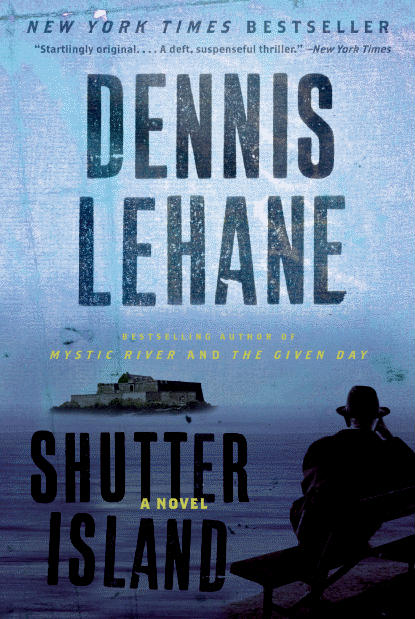
Shutter Island

Review By Phil Gray

Teddy is a head case, a regular wacko, I’m warning you in advance. Shutter Island, the book, is carved into four parts; Rachel (Day One), Laeddis (Day Two), Patient Sixty-Seven (Day Three) and The Bad Sailor (Day Four). Just in case you can’t count, even while using your fingers, the splitting of the book means that the story is set over four days. Four days full of mayhem and wandering around an island investigating the disappearance of Rachel Solando. Oh, yes this seems like a normal day at the office for U.S. Marshal Teddy Daniels. With him tracking vanishing women, being hit by storms, scaling cliffs, hanging out with beady eyed rats and having strange dreams about his wife.


His wife, by the way, is a loon too. Not that I’m giving much away by saying that, it’s kind of obvious from the start that you shouldn’t leave her anywhere near a cutlery draw. I quite enjoyed this book by Dennis Lehane, it’s not something I’d normally read as it doesn’t have any beeping robots in it. The plot is a bit holey though, especially when it gets past Teddy having a seizure. The way that Teddy is manipulated at the end is a bit dumb too. Nobody wants to tell him outright what is going on, even though in my opinion it would be in the best interests of all parties involved. Not that I’m a qualified psychiatrist, it just annoys me when people don’t tell the truth. There’s plenty of porky pie weirdness going on in this book.


Leonardo Dicaprio getting sweaty. Now that got your attention. Although, it’s not the kind of sweaty that you’d like, puking over the side of a boat and having massive headaches without the night before drinks bender sweatiness. Along with this special appearance of sweat, Leonardo Dicaprio (portraying Teddy) is the master of the fighting eyebrows, those caterpillars of hair only separated by a brow that is forever creased. Maybe he was having problems remembering his lines or his original 1950’s pants were riding up his crotch too much. In Contrast, Mark Ruffalo (playing Chuck, Teddy’s new cop partner) looks at ease in the 1950’s setting, oozing charm and moving with the grace of a dancing butterfly.


The film of Shutter Island has a powerful cast and an all-powerful director. Martin Scorsese at the helm commands a lot of respect, just from his previous manifesto of directed film work. I sneaked a look at what other reviewers had said about Marty boy’s directing. It wasn’t good, which is weird, as I like the way this film is directed. It has a noire feel and the pacing that is needed for a psychological thriller. The only scene that I thought wasn’t portrayed very well was the change in the relationship between Leonardo Dicaprio and Mark Ruffalo, when Leonardo (Teddy) pushes Mark (Chuck) away rather limp handily. The switch in friendship is too quick and brushed over, which I guess can’t be helped as a film has a limited amount of time to get its message across.


Which is better then? A heavy weigh director backed up by champion actors, or a book written by one man who likes his rivers to be mystic? It’s a hard choice, as both have their fantastic moments of truth and realism (slightly warped and wearing a skirt Dolores). The book does an amazing job of showing the inside of Teddy Daniels head, something that the film comes nowhere near. Teddy’s exploding headaches are given a whole extra dimension under the craftsmanship of the book writer, Dennis Lehane. The book is well written and splits the story of Teddy Daniel’s crazy obsession with anagrams up perfectly. I didn’t have any problem following the threads that Dennis Lahane laid down, something that apparently many people had a problem with in Martin Scorese’s film version (the twisty turns); maybe the general public are just a little bit thick.


Not enough explosions and muscle pumping to entertain the average audience or maybe too many crazy dream scenes with encrypted flash backs. Why are you all wet, baby? Another lovely example of encryption used in both book and film. The average audience was probably saying ‘I’d like a refund on this film, as it distracted me from eating my popcorn and scratching my butt crack’. I personally loved the visualisation of the fake pistol scene in the lighthouse. Ben Kingsley having tomato ketchup squirted over himself and then instantly removed without the aid of washing detergent. I’d say in my professional opinion that the book and film are on equal par. Excuse me, while I get back to my anagram making and 1950’s hat wearing.

Saturday, 24 September 2011

Red Dog

Review By Brendan Paholski


Red Dog (the book)


Red Dog covers the life story of a Red Cloud Kelpie , in Western Australia between 1971 and 1979. When the story opens, his owners are Jack and Maureen Collins. At a barbecue Tally Ho (his original name in the story) doesn’t return to his owners , and he goes away.

John becomes his new owner. Red Dog and the men from the Hamersley Iron Transport section get to know each other after John the driver adopts him. John becomes the only person to whom Red Dog truly belongs. As Dampier grows, more people begin to befriend Red Dog. Nancy and Patsy are two characters who come into the story, as a result of one of them noticing that Red Dog has been shot. Nancy calls John, and he and his friends decide to stop work so they can save Red Dog. In the finale to part one, John has an accident while riding on his motorbike.

Part two of the book sees Red Dog looking for John. His journey takes him to a caravan park where Nancy has Red Cat. Red Dog and Red Cat do not initially get on well. The caravan park has a “no dogs” policy, so when Red Dog stays with Nancy, the park’s caretakers, the Cribbages, decide to kick Nancy out. The rest of the town objects to this. The last journey tells of Red Dog’s untimely end .

The book is of an episodic nature (as it surely must be), but hangs together well. Occasionally the dialogue is a little awkward, where some conversations/expressions seem to lack verisimilitude.
The book also includes a number of Australian terms in a glossary.However, describing someone as a dag doesn’t make them “revolting”, as this list would have it, but merely quirky or eccentric. Have a look at the list and have a good chuckle.


Red Dog
(
the film)


The film opens when a truck driver on long-haul delivery walks into a bar. Instead of the convivial atmosphere one might expect, he encounters gloom, as Red Dog (played by Koko) has been poisoned. The entire Pilbara region knows the dog, and is deeply upset at his situation. The worried expression of the publican)Noah Taylor) says it all. Red Dog may not make it through the night.

In the course of the next few hours, people flock to the bar to find out the prognosis and the hound's situation. All have tales to tell about the dog to the truckie (Luke Ford) about their relationship with the dog.Red Dog has clearly had a busy life, and as the narrative torch is passed around the bar, various events in Red Dog's life are recreated.

This is a well told tale, albeit of an episodic nature. The direction ( by Kriv Stenders) is exceptionally good, and the cinematography of the Pilbara region is not be understated.

The other remarkable thing about the movie is the soundtrack: songs from the Seventies (the story is based on events from 1971 to 1979) including Way Out West (The Dingoes), Bom Bom (Daddy Cool) , Stumblin’ in (Suzi Quatro / Smokie) and Rose Tattoo’s We Can’t Be Beaten truly make the story .

The film has some delightfully quirky scenes (betting on how fast Red Dog eats a can of dog food), and manages to synthesize pathos with humour at precisely the right pace.

By the way, check out Koko’s screentest.

www.youtube.com/watch?v=6Su66nlzKC0

Comparing book and film
When he was in Karatha in 1998 for a literary dinner, Louis de Bernieres discovered the statue of Red Dog outside Dampier. Intrigued, he set about researching the story. The result was the book Red Dog, published in 2001. The film found its star (Koko) in 2009.

De Bernieres took parts of the real story and dressed them up a little to make what would have been a series of random tales a cohesive story. Thus the film achieves this as well, albeit with a few subtle changes. John (a part-Maori in the book ) becomes an American in the film. The film also uses a well-worn technique (a stranger comes to town), to retell part of Red Dog's tale.

Both book and film suffer from an overuse of cliche, whether in dialogue or in action (the final Red Dog/Red cat fight is a prime example in the film) and some readers will find some odd expressions and sentence structure in the book. In the film, there is definitely tension between the real and the "hyper-real" in the dialogue.

Some episodes from the book are excised from the film , but those which are included are inspired, including any involving the Cribbages.

Overall, Red Dog's story probably works better as a film, where there is more scope for a true but "tall"story.

Friday, 9 September 2011

Twilight

By Ash Shaw

- Book       
- Movie

Genre: Young Adult/Romance/Fantasy
Age Group: It is suitable for people 13 years and over, but is probably aimed more at females.

Book Review
Stephanie Meyer’s Twilight, book number 1 of 4, is a story about a young girl named Isabella Swan who falls in love with a vampire named Edward Cullen. The first instalment in the series shows the hurdles both Edward and Bella have to overcome in order for the two of them to be together. It is written in the viewpoint of Bella and switches between her internal monologue about Edward Cullen and his family and also her more awkward and self-conscious reactions to those around her. Meyer took a bold leap for her first novel by writing in the first person (Bella’s viewpoint), but she has definitely pulled it off. I was immediately drawn in because I felt more of a personal connection with the narrator and I felt this throughout the rest of the story. As a reader I was able to not only see, but also feel how self-conscious and awkward she is and if this was written in the third person I don’t think it would have the same effect on the reader and might detract from the story itself. Her characters, both main and otherwise, are all well-rounded and thought out and each has their own personality which adds more to the story. Overall, even though the romance side of the book is somewhat corny at times (as most romance novels are), Twilight is packed with enough drama and action to override this. Even those who are cynical about romance, especially between two teenagers, will be able to overlook the corny bits. It is suitable for people 13 years and over, but is probably aimed more at females.


Movie Review
The movie adaptation of Twilight does not differ too drastically from the book. All of the characters look just like they are described in the book, even if they are not what I had pictured in my mind. Bella (played by Kristin Stewart) is more sullen than the book describes, however, Stewart plays this character well and is able to capture every other emotion described in the book. Edward (played by Robert Pattinson) is the perfect match for Edward and he plays the part brilliantly. As the Cullen family are all vampires, they are supposed to pale, but in the movie their skin tones are a little too overboard. All of the big, dramatic scenes have been included in the movie and the special effects are believable for the most part. I thought they did a great job for the scene where Edward reveals to Bella why he cannot walk in the sunlight. My favourite scene is the one where Bella tells Edward that she knows what Edward is. It is full of tension and latches onto the people watching and pulls them into the movie and right there with Bella and Edward. This movie is definitely a must-see for those who like suspense, romance, drama and action all in one.


Comparison
It’s a very close decision between the two but the book definitely wins out over the movie, only by one star though. This is partly because there is always just that little bit of extra detail in the book and partly because I just enjoyed reading the book that little bit more than watching the movie. For a movie adaptation it is definitely the best by far that I have seen in the respect that have followed the book’s details and characters very closely, probably for the readers sake, which is another thing that I appreciated about it. They have thought of not just the people wanting to see the movie, but also of those that have previously read the book. I saw it twice at the movies because I am one of those people who pick apart movie adaptations if I love the book, so the first time I went I picked it to shreds and then I re-read the book. The second time I saw the movie I actually just watched it as a movie and not as an adaptation and it was then that I was able to fully appreciate it and recognise how much thought the creators put into it and how closely they have followed the book. I always think it’s best to do this if you are like me, a loyal bookie! 

Tuesday, 6 September 2011

Jane Eyre

Review By Brendan Paholski


Jane Eyre (The book)


Jane Eyre, by Charlotte Bronte, is the story of a penniless orphan's journey from childhood ostracism through to marriage and a career as a governess. When we first meet Jane, she is in the care of her resentful Aunt, Mrs Reed(I use the term "care" advisedly, as it usually abuse, both physical and mental, that she endures). After being locked in the "red room" as punishment, and seeing visions of her dead father in the room, Jane is sent to Lowood school.


Jane's situation is not improved at Lowood, where she is accused of being deceitful, and is publicly humiliated by Mr Brocklehurst for dropping her slate. Eventually she is cleared of any wrongdoing by her teacher, Miss Temple. She prospers at the school where she eventually becomes a teacher herself.


After eight years at Lowood school, Jane takes matters into her own hands and advertises herself as available for the role of governess. Ultimately she becomes governess at Thornfield Hall to Mr Rochester's child, Adele. The real story of Jane Eyre's life begins.


The novel is an excellent example of writing (and subject) which is ahead of its time. In our protagonist, we have a woman who, though reserved initially, is forthright in her opinions. Jane tells her own story as she sees it, and is an acute observer of people and situations within the household, as she often overhears gossip and tittletattle. She can often be found one room removed from social functions at Thornfield. The first-person perspective allows the reader to see Jane's vulnerabilities as well , and allows for the perfect unraveling of the tale.


The novel embraces many genres, being part romance, part Gothic (Jane's vision of her uncle, her dreams of children and the "fortune teller"), part coming-of-age and part autobiography (the death of Jane's friend Helen Burn mirrors Bronte's own experience, where two of her sisters died in childhood of pulmonary tuberculosis). It remains a favourite among readers.


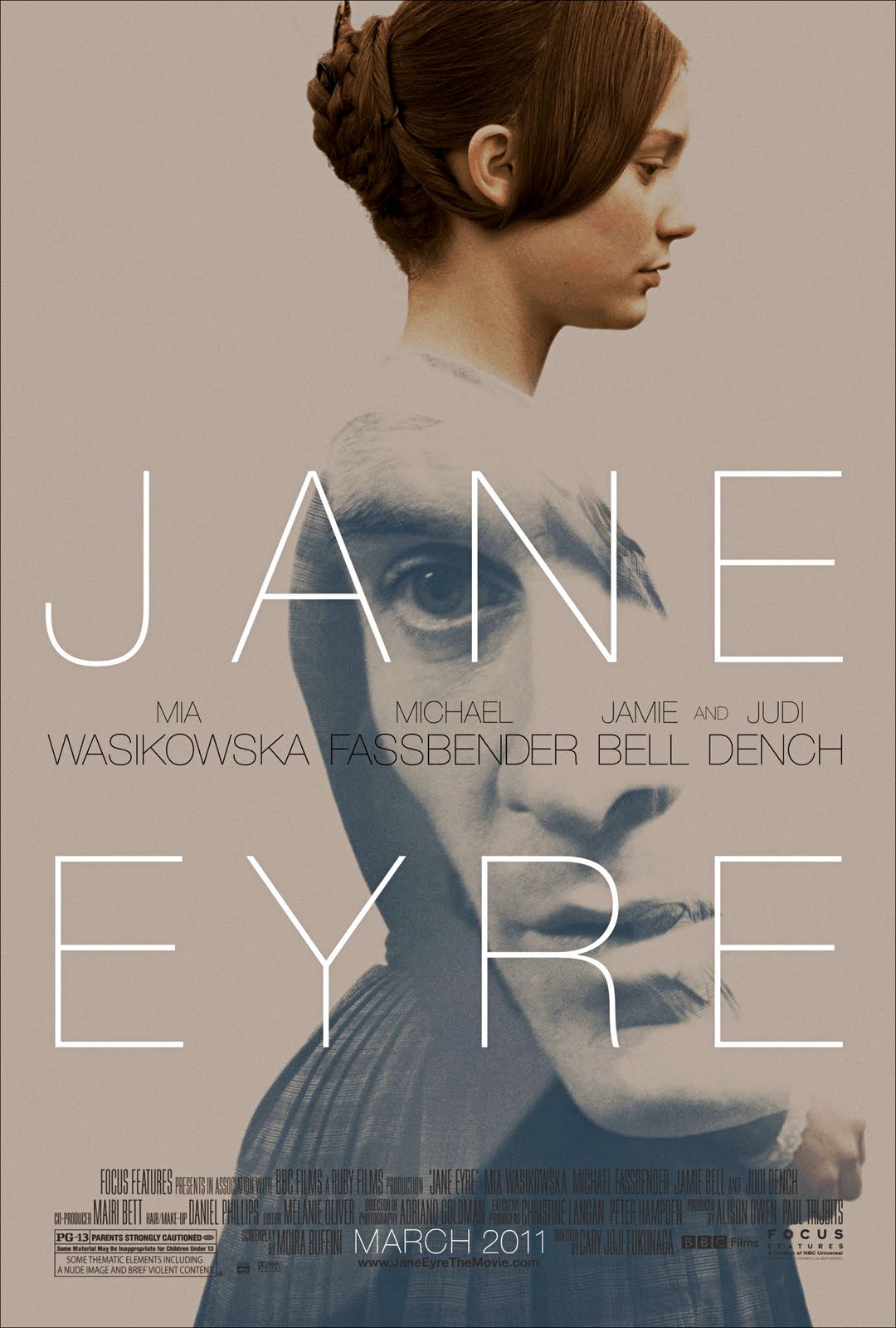
Jane Eyre (the 2011 film)


Since 1915, there have been sixteen film adaptations, and ten television adaptations of his classic story. (including I walked with a Zombie, a 1946 movie loosely based on the novel). The latest movie version (2011) stars Mia Wasikkowska and Michael Fassbend in the the principal roles, and features most of what you expect from such a retelling (dark interiors, nast weather and some cruelty early in the screenplay).


The most remarkable aspect of this version is its structure: it dispenses with a linear retelling, opting instead to begin proceedings with Jane's flight from Thornfield. Thus the mystery is able to continue, as she is ushered into the household of St John Rivers, and reveals her name to be Jane Eliot to all who question her.


The film seems to have the right balance in terms of the main actors and Dame Judi Dench is perfect as Mrs Fairfax. As the younger Jane, Amelia Clarkson is excellent. All the exterior locations create a spectacular backdrop for the retelling of such a novel. The interior shots are also suitably gloomy.


Comparing book and film


This is always difficult. Any movie interpretation of a well-known novel draws plenty of different opinions, and this one is no exception. As I've mentioned, many versions of this story exist on film
and each will have its good and bad points. Its easy, when reading the novel, to see why its become such fertile ground for those in film and television over the last one hundred years. It would provide a challenge to any screenwriter or producer to find something different to say from a well-worn tale.


In its 2011 incarnation, the story has been given a begining with a dramatic tableau, so that much of the story is then told backwards. Parts of this idea work wel, but I found that several jumps in the story seemed to jar, and were not explained clearly and assumed a reading of the text. (How was Jane liberated from Lowood? When she is permitted to attend school , how does that arise?)


My other major problem with this movie is that it all seems to end very abruptly. When the film ended, I found myself wondering " What happened?" because the entire denouement seemed to happen so quickly. It was as if the entire cast and crew couldn't wait to get out of there.


I was left wondering whether Gary Fukunaga (director) or Moira Buffini (screenwriter) had read the book that closely. I'm not sure that this would rate among the best interpretations of the novel on screen.